Five days until the wedding and no cold feet so far...
That could be referring to something Jesus said about marriage. Though I tend to think in heaven it will be less like "being single again" and more like loving everyone as much and as intimately as you love your spouse...
4.30.2007
4.28.2007
"into a broad place"
I prayed Psalm 18 early this morning by candlelight...
I love you, O Lord, my strength.
The Lord is my rock, and my fortress, and my deliverer,
my God, my rock, in whom I take refuge,
my shield, and the horn of my salvation, my stronghold.
I call upon the Lord, who is worthy to be praised,
and I am saved from my enemies.
In my distress I called upon the Lord;
to my God I cried for help.
From his temple he heard my voice,
and my cry to him reached his ears.
He reached from on high, he took me,
he drew me out of many waters.
They came upon me in the day of my calamity;
but the Lord was my stay.
He brought me forth into a broad place.
4.27.2007
giving and receiving gifts
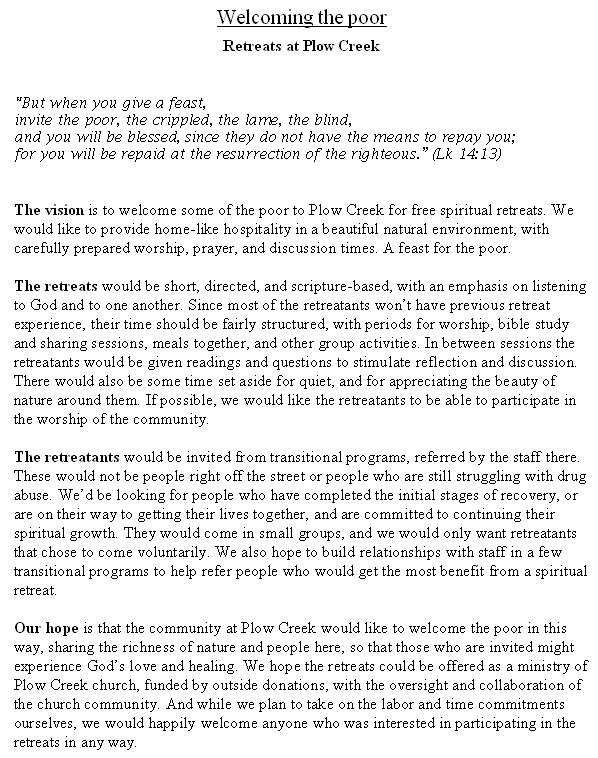
Our plan for a small retreat house for the poor here was based on the image of "a feast for the poor," from Luke 14 (you may need to click on the image for full size). It follows the desire to offer gifts to the poor, a concern I mentioned yesterday. For quite some time I've been trying to follow Jesus into a life in which all my work and all that I receive are gifts. Now I'm trying to more intentionally direct gifts to the poor.
As I said yesterday, I'd like to encourage that here, too. But I understand that transition will be slow, and may not go as far as I would like. So I've been trying to see how God might have me participate in the work of the community here, while still living Jesus' model of gift giving and receiving.
This desire may fit with the work needs here. Both the farm and bakery struggle financially, and usually cannot afford to pay hourly wages (so the bakery work has been mostly done by volunteers, and the main farm workers all agreed to take need-based shares of the farm income, as well as lots of fresh vegetables!). That's fine with me, because I'm not interested in working for wages. I could just help out as needed, and ask that the farm and bakery make donations to the retreat ministry as they want to and can afford. Outside donations (hopefully!) will also support the retreat ministry, which will be a ministry of Plow Creek church.
Heather and I will then go to the church for our needs, which can be provided from the various donations. God willing.
From what I've seen so far, he is.
4.26.2007
come, glean
I was up on Blueberry hill with Kevin this morning, helping mulch the new plants they put in yesterday. It's nice and quiet up there. And there's more of a calm, unchanging feel there, since the blueberry bushes grow and produce berries for years.
On our walk home, I asked about surpluses of things like watermelons, sweet corn, and tomatoes. Kevin said that he'd tried giving some of it away. He even found one guy from a local charity who would bring people to glean produce that hadn't been picked (because there was an excess of that crop). That sounded good to me. I'd like to encourage and help organize more of that.
One part of work on a small farm (and bakery) that has raised questions for me is how the customers tend to be the more wealthy suburbanites. Especially when, to cover the expenses of a small operation, the farm focuses on growing the more expensive produce, like berries. I think growing good food or making good bread is very worthwhile work. But for me it takes something away to know that only the richer people will enjoy these good things.
It reminds me of a friend who is a potter in North Carolina (we hope to visit him this summer on our walk). He is an excellent craftsman; his work is beautiful. But to make his living by such work he needs to charge prices that only fairly wealthy collectors can afford. That bothers him. Me too.
But much of the produce and breads made here also go to the families who live here. I like that. I'd feel better about the work, though, if we can find a way to produce more nourishing gifts for the poor rather than luxury items for the rich.
4.25.2007
trilliums
 Heather and I were clearing brush around the retreat cabin here the other day, preparing it for our honeymoon. And near the cabin under the trees Heather discovered some beautiful deep red trilliums. The flowers are just opening, so I imagine they'll still be around after the wedding.
The shape of the flower is striking. It reminds me of the Celtic trinity knot symbol that we chose for our wedding rings (thanks Mom and Dad for that gift!).
4.24.2007
going to the common cathedral
Last week I got a response from Mike O'Grady, a Jesuit in the Boston area, offering hospitality and encouraging us to come for a visit in early July. I had written to him because Heather and I are planning to start our walk there.
It's the location of Ecclesia Ministries, an ecumenical group that has offered church for the homeless outside on Boston Common for over twelve years now. They call it the common cathedral. Here's an excerpt from their latest newsletter:
A man shared about his first experience at common cathedral. He said he had gone to a church dressed in his street clothes, clean and neat, but casual and not wearing a white shirt and tie like all the other men he saw there. The ushers made it clear that he didn’t belong and escorted him to the door.
Hurt and angry he walked over to Boston Common and encountered a woman who said, “You look like you need a friend.” It was Debbie Little who had greeted him many years ago. He now calls common cathedral his home.
When asked how he found common cathedral, a man who always used to sleep on a bench near the fountain laughed and said, “One afternoon when I woke up I was in church.” Our altar and cross were in his bedroom.
4.23.2007
wildness
Ever since my walk out west, I've been using cimarron as an online name. It's an Apache word, meaning "wanderer," a synonym for pilgrim. But it also has another interesting usage. When the Spanish moved into the Apache territory in western North America, and took it over, they adopted the word cimarron. But the Spanish meaning of the word is "wild." It was used to describe a native Apache who had been "civilized" (enslaved and domesticated by the Spanish) who then escaped and returned to his "wild" (native) ways. I like that image.
I was thinking about wildness yesterday, as a storm front moved in. It's been a concern of mine recently. It may have something to do with my series of reflections on aggression last week; I remember writing, "I don't want to be domesticated."

And how does that put us in relation to the Spirit who "blows where it will", the God who is a "consuming fire"?
I believe this will be an important concern for me as I try to find my purpose here. Our wildness is a gift of God, the free expression of who he created us to be. We must not subdue it.
4.21.2007
in the setting sun
I've been getting my hands dirty here, helping with some early planting and even some weeding already. The physical work is harder than I'm used to. But I've been trying not to work so hard or with such fixation that I'm not aware of what's going on around me.
Like the tree frogs chirping in the woods at the edge of the field. Or the vultures silently circling high above.
Yesterday, we were setting up irrigation piping for the new strawberry plants we just put in. The field was a dry gray expanse, the plants tiny and indistinguishable from the dirt. So we brought out the thirty-foot pipes, hooked them up without too much problem, and soon water was flying. But puddles began to form where some pipe connections were leaking, and some of the sprinklers didn't work right. So we began the slow, frustrating task of fixing seals and adjusting sprinklers and replacing pipes. Some leaks were persistant. And each time we separated the pipes more water gushed out, making mud. Lots of it. The process dragged on and on, and we began to get tired and hungry for dinner.
But when we turned on the water again the last time, I saw something beautiful. In the slanting rays of the low afternoon sun, as the fine spray slowly darkened the soil, I saw them. Where before there had seemed to be only an expanse of dirt, now long rows of tiny green leaves glistened.
I stood there for several minutes and enjoyed the sight.
4.19.2007
ever patient, ever tactful
Yesterday was my mother's birthday. I made her a card using this cartoon...
4.18.2007
"he who is not with me is against me"
That's not the president I'm quoting, it's Jesus. The passage I quoted yesterday, "he that is not against us is for us," reminded me of this other saying of Jesus that seems to say almost the opposite:
He who is not with me is against me,
and he who does not gather with me scatters. (Mt 12.30)
In the current political scene, words like these have been used to strike fear and squelch dissent. But in that realm, such a statement is ultimately untrue, in that there could certainly be opposition to certain bad decisions or political positions that is not "against" the president or the country but "for" them, for their good.
This statement is true, however, when Jesus speaks it. And it is not a contradiction of his words quoted yesterday. Both statements say the same thing: We are either with Jesus or against him. There is no neutral ground, no "undecided," and obviously no loyal opposition.
It seems important, though, to repeat yesterday's observation that Jesus' way of seeing who is "with him" is different from our usual way. We see families and political parties, pledges of allegiance and membership vows, alliances and official affiliations. But Jesus sees himself united with "whoever does the will of God." If God is acting through us, we are with him then, no matter what our church membership status. And if we are resisting God's work (even just resisting God's attempts to use us), then we are against him, no matter much we profess Jesus' name.
"You will know them by their fruits. Not every one who says to me, 'Lord, Lord,' shall enter the kingdom of heaven, but he who does the will of my Father who is in heaven." (Mt 7.20-21)