10.26.2010

it's in


It's been a busy week, but we worked together all day yesterday and managed to get the wood stove installed before the first freeze (and before Jason and Julissa arrive for a visit). The natural slate tiles were Heather's idea. Lots of work, but we're both very happy about how well it turned out.

Now I need to go find some dry wood to try it out...

10.17.2010

at the altar

We were supposed to have a retreat this weekend, but something happened. Our guests never arrived at the train station. We're still trying to figure out what went wrong on their end, since we've heard nothing so far. It was a pretty big disappointment, but I guess that just shows how much we were looking forward to having them here. And I imagine we'll get another chance.

So yesterday we served some of the food we prepared for the retreat to our friend Jacob Mau, who was here on his own retreat for the weekend. He was a farm intern this past summer. He's also an excellent songwriter, and gave us a intimate campfire concert last night. Here's one of the songs he wrote (and there's more on his myspace page): "At The Altar"

10.15.2010

I almost sent this to my dad for his birthday, since it's election season...

10.11.2010

"trying to chip away at the tower of Babel"

From yesterday's online conversation on "the grid" and our technological society...


I agree about living as exiles and aliens. I like the tower of Babel imagery, too. Maybe my resistance here is that I think you have misidentified the problem. It isn't the grid or technology, though those do reflect it, to some extent. God didn't tear down the tower of Babel as I recall. The tower (technological marvel that it was) wasn't the problem. The problem was the people, their pride in their collective might, so God scattered them.

Even if we can get out of technological society (and most of us can't, maybe none of us can completely) the pride of collective might and the domination that follows it still remain in the people. That's where the problem lies, in us, not in the technology. So I see the attack on technological society as somewhat misguided. Trying to chip away at the tower of Babel, when it's the people, the builders, who are the problem.

I also think the focus on the personal is important because our hearts can be changed even when the grid around us doesn't change. And God can allow us to benefit from the good that is available in our technological society, and not be enslaved by the evil. Our life can be good, not just when society is arranged well, not just when we're finally off the grid, but when God shows us how to live with freedom in our society. As Jesus did in his society.


...I do agree that there are dangers (along with benefits) and it's worthwhile to weigh these and we may choose not to use certain technologies for a variety of reasons. I also agree children are especially susceptible to the temptations and pressure, so special care should be taken.

And I agree with what you said earlier about evil being the absence of good. That's part of why I can't dismiss the grid or other technologies as utterly evil. There is some real existence there, some conforming to the laws of nature that makes electricity "work" and metals and other materials serve so well for certain useful purposes. Thus I see some good in these things, or at least potential good if they are used well. You're right that it's important to weigh the cost, and often we haven't done that well. But there are real benefits to be weighed as part of the equation and it doesn't serve your argument to dismiss them.

I also believe that every "thing" that God allows to have real existence in the world has at least some potential for good. So we should honor that and try to understand why God would allow it and then be open to the good it may offer. Certainly, there are some things like nuclear weapons that seem to have no potential good except to reflect back on us the evil in our own hearts and show us the devastation that results when we ignore conscience and the needs of other human beings. Maybe you see the grid and most technology in this way. But that's pretty hard to swallow, given that many of us have experienced some goods from a variety of these technologies and are grateful (perhaps even awed) that God has allowed them to have existence.

Again, that doesn't mean we should accept every new technology or use it without care or thought for the costs. It's just that there are many technological goods available to us that need not be completely rejected, and many of them can be used well with the freedom that God offers, and even received as a gift from God. Even acknowledging the pressures and perhaps unholy intentions of the designers, God can help us find the good there and benefit from it. I think that's part of God's gift of the good life in the midst of an oppressive society.

For example, the much-reviled ipod. I received one. I didn't buy it, wouldn't have bought one, can't afford one. But my brother had an old one and sent it to me. I figured out how to use it with free open source software, and downloaded free songs. So now I can enjoy some music when I couldn't before. There was a time many years ago when I gave away my music player and CDs, which was a good choice then, and I went for years without the option of playing music besides the little flute I have. That was fine. But to receive back the ability to listen to lots of music that I really enjoy has been a real gift, and I've seen it as one of the many signs of God's generosity and power to use anything (even technological society) to give good things to those who look to him for our needs.

And I still play my flute, as I did while worshiping outside by the creek yesterday. And I'm probably not using the ipod as Apple hoped I would. But it's an impressive little thing. And I'm grateful for the enjoyment God has given me through it.

10.09.2010

a house warming gift

It's starting to feel like fall. We had a light frost last weekend and now the leaves are quickly turning color. And falling; I was just out raking them, starting to get ready for the retreat we are hosting next weekend.

I also just asked permission to install a wood stove in our place, to make this winter a little warmer than the last few. The stove is free, one of the few things that survived the terrible house fire here this past spring. We'll need to clean off the rust (it got a little wet in the firefighting) and paint it. And then build a stove pipe chimney. But it looks like it could be in place before the cold weather hits, which would be quite a welcome gift. It would also make our place cozier for guests.

The retreat next weekend will be the fourth we've done this year, for groups from four different ministries. That spreading interest is a real encouragement. Maybe the wood stove would make is possible for us to have groups come in the winter as well.

10.05.2010


10.03.2010

just the words we need to hear

A thought this morning from the continuing hospitality discussion on Jesus Radicals...

I think that "radical" hospitality (and other good deeds) that are motivated by passages like the sheep and goats parable of Mt 25 can often be done more for ourselves than for the ones we're serving. Trying to "see Jesus" or "encounter Christ" in our care for the poor. Looking for a fuller experience for ourselves or a deepening of our own spiritual lives. Which is perhaps not the best motivation for loving others, is it?

But we often do encounter Christ in the experience, just not like we expected. It's often not so much Jesus saying to us "Well done, good and faithful servant" as what he said more often with his disciples, "O ye of little faith!" These, though, may be just the words we need to hear. So the experience is what God wanted for us after all.

Part of the learning, at least for me, is that serving others (especially the most vulnerable) shouldn't be about my own encounter with Christ. It should be about loving my neighbor, about their needs, not mine. That's part of why I resist an emphasis on Mt 25 in this context (I notice that in Mt 25 the righteous do not know that it is Jesus that they are serving; see Mt 25.37-39). When their needs are my focus, then there's no value in sentimentalizing them, or pretending they are mystically more holy than they really are. It's just about seeing their real needs and responding the best we can. Like the good Samaritan did. Seeing them not as some "blessed" category (because they are poor or afflicted) but just as human beings who have needs and failings and brokenness like any other. Who need Jesus' healing just as we do. And sometimes Jesus' rebuke, just as we do.

Then I think we're much closer to experiencing Jesus present, not just "to" us, but in us and through us.

9.28.2010

christ on the hillside

A conversation on the (new!) Jesus Radicals site has me thinking about my experiences at the Catholic Worker. Some hard days there. I referenced a journal entry from that time, trying to caution people about the challenges, and it reminded me of my hopes then "that there is a 'blessed' life that we are called to that is blessed in reality and not just in imagination." The vision of "Christ in the Breadlines" wasn't working for me any more.
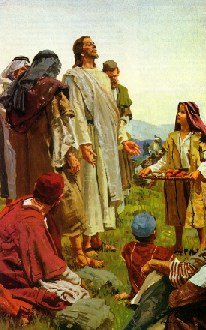
Jesus described the life of the kingdom of God as "blessed." And when we look at the life he and his disciples lived, we can see that blessedness. It's not a life mired in the dirt and degradation and violence of the "Christ in the Breadlines" ideal, as far as I can tell. During my Catholic Worker days, I felt myself being drawn more and more to the vision of Jesus on some hillside, like when he preached the sermon on the mount, with people coming out to see and be healed by him. Jesus' kingdom life drawing people out of the mire of their lives. His invitation inspiring them to long for and eventually receive the good life that Jesus himself lived. My "Christ on the Hillside" vision. Still a poor, vulnerable Jesus, but living the blessed life of the kingdom.

And, since then, Heather and I have been shown something of how that might be experienced now. We've been led to a hillside of sorts, from which to invite the poor out of the pressures and violence of the city. And we're still able to live a life of voluntary poverty, but a beautiful poverty. A life of the kingdom that is "blessed" not only in a spiritual sense but also materially and relationally, because "your Father knows your needs." I hope that can be a witness and encouragement to others who see it.

In any case, it's been a great encouragement to me. I'm very thankful.

9.26.2010

out in it


This is from a stretch of road I often walk. The setting sun made the grass glow.

9.23.2010

first day of autumn