2.15.2006
2.14.2006
"the poor and sinners"
It is often pointed out that Jesus surrounded himself with the poor and sinners. And this is certainly true. Yet I don't think it's immediately clear who these "poor" and "sinners" actually were. It could also be said that we at the Catholic Worker house are surrounded by the poor and sinners (it often is said), but are these the same kind of people that Jesus spent his time with?
I've said before that my experience made me wonder about this. When I read the stories of Jesus and compare it to the people I'm encountering here, it seems markedly different. And I think the difference has something to do with the difference I've identified between "the poor" in general and the anawim.
When we hear of Jesus living and interacting with "sinners," they do not seem to be people still committed to their sin and engaged in it. I could be wrong about this. The sketches of Jesus with outcasts are often vague. But they seem to be with people who have been involved with disgraceful activities but who are interested in Jesus because they want to change. The specific accounts we have, such as Jesus' meal with Zacchaeus, show repentant sinners. Another identified sinner I recall is the woman who washes Jesus' feet with her tears. And then there's this famous passage in the second chapter of Mark:
As Jesus passed on, he saw Levi the son of Alphaeus sitting at the tax office, and he said to him, "Follow me." And he rose and followed him. And as he sat at table in his house, many tax collectors and sinners were sitting with Jesus and his disciples; for there were many who followed him.Here it is clear that Jesus is gathering with previously known "sinners" who are now his followers. His last statement emphasizes that it is their realization that they are sinners that sets them apart from the Pharisees (who are not righteous, but think they are, and so are not open to Jesus' message). Again, Jesus is spending his time with those who are willing to turn from their sinful ways, willing to follow him out of their misery. He is not surrounding himself with those who are sinners who are happy to continue in their destructive ways. These have no interest in Jesus.
The scribes of the Pharisees, when they saw that he was eating with sinners and tax collectors, said to his disciples, "Why does he eat with tax collectors and sinners?"
When Jesus heard it, he said to them, "Those who are well have no need of a physician, but those who are sick; I came not to call the righteous, but sinners."
We see the same among those who crowded around Jesus for healing. Those who come to Jesus come with faith in him as a prophet of God. They come for a miracle. So often he says, "Your faith has healed you." And when the people have little faith, there is little healing in that place. "He did not do many mighty works there, because of their unbelief." (Mt 13.58) The people that come to him are people who are in need and believe that God will help them through Jesus. These are the anawim.
Those who came to attack Jesus were those in power, who felt threatened by him. These were his persecutors, who he rebuked. He was not caught in the strange situation that I've often faced here, of being attacked by a person I'm trying to help, or dealing with a demanding beggar. Or providing food and shelter to someone who will go off and use drugs as soon as the next opportunity arises. But, as I've said before, Jesus put himself in a different position. What he offered did not draw the demanding beggars (except perhaps in John 6, then he repelled them with his teaching) or abusive drunks. He drew the faithful poor and sick, repentent sinners--and the persecuting powerful.
These are also the ones I'd like to be dealing with. So how did he do it?
2.09.2006
"a broken spirit"
Another place the Psalms speaks of the anawim (poor, afflicted, lowly, meek) as God's faithful ones is Ps 37.9-11:
The wicked shall be cut off; but those who wait for the LORD shall possess the land.Here the anawim are contrasted with the wicked. (Notice also the parallel with Jesus' words in the sermon on the mount: "Blessed are the meek, for they shall inherit the earth.") Not just the poor, but the faithful poor.
Yet a little while, and the wicked will be no more; though you look well at his place, he will not be there. But the anawim shall possess the land, and delight themselves in abundant prosperity.
So what distinguishes these poor, afflicted ones from others who suffer (and also from those who don't suffer but enjoy power and wealth)? They "wait for the Lord." They look to God for protection and deliverance. They don't trust in their own power or abilities or resources, and they don't trust in other gods or other people, but they trust the Lord. This is what sets them apart as the faithful, or righteous, as the psalmist calls them at the end of Ps 37:
The salvation of the righteous is from the LORD;
he is their refuge in the time of trouble.
The LORD helps them and delivers them;
he delivers them from the wicked, and saves them,
because they take refuge in him.
It's easy to see how material poverty and powerlessness might lead us to stop trusting in our own strength. Wealth and power work the opposite way (hence, "Power corrupts"). Jesus chose a life of poverty and powerlessness to perfectly demonstrate what trust in God means, what the blessed life of complete dependence on God looks like. But there are those who are poor and weak who still do not trust God. I frequently meet poor people who trust drugs and alcohol instead, though these are slowly destroying them. It's incredible the depths that people will sink, and still convince themselves that they can handle their own lives. Last night a guy showed up again on our front porch, so drunk he couldn't walk, hadn't eaten all day, facing a 20F night with no blankets and no place to stay--and still he mumbles that he'll straighten his life out tomorrow. He's been saying this as long as I've known him.
What is required is admitting our own helplessness and turning to God in hope that he will rescue us. And he will. As David wrote in Psalm 51: "The sacrifice acceptable to God is a broken spirit; a broken and contrite heart, O God, thou wilt not despise."
This broken spirit is also the starting point in 12-step spirituality. It means admitting that we are powerless over our addictions, our problems, our lives. It's not just admitting that we can't handle drugs or alcohol (though that's usually what people admit first). The deeper truth is that we are powerless to make our lives and ourselves good so that we won't want to escape them. It's only when we let God change us and give us life as a gift that we can be happy and satisfied enough to not want those false (chemical, psychological, financial) escapes that ultimately destroy us. But this means giving up control of our lives. It is not easy. The 12-step programs recognize that great suffering is usually necessary to bring people to the point of admitting powerlessness, so they tend to let a person "hit bottom" so they can find the broken spirit that they need before God.
So there is a definite connection between real material need, affliction, humiliation, and the poverty of spirit, the brokenness of spirit we need to receive God's blessed life. But there are also many of us who suffer these things and yet refuse to be broken. These poor, afflicted ones are not the anawim that Jesus had good news for. These have no interest in Jesus. These are the ones whose lives have become a living hell, because they won't admit defeat.
2.08.2006
more on Jesus and the poor
Another passage that speaks of Jesus' concern for the poor (and afflicted) is Luke 4.16-21:
Jesus came to Nazareth, where he had been brought up; and he went to the synagogue, as his custom was, on the sabbath day. And he stood up to read; and there was given to him the book of the prophet Isaiah. He opened the book and found the place where it was written,
"The Spirit of the Lord is upon me, because he has anointed me to preach good news to the poor. He has sent me to proclaim release to the captives and recovering of sight to the blind, to set at liberty those who are oppressed, to proclaim the acceptable year of the Lord."
And he closed the book, and gave it back to the attendant, and sat down; and the eyes of all in the synagogue were fixed on him. And he began to say to them, "Today this scripture has been fulfilled in your hearing."
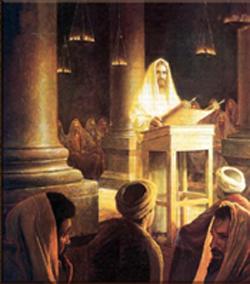
This is often used to verify Jesus' connection and commitment to poor people in general. And the setting seems to reinforce this. Nazareth, I believe, was pretty poor then. But the verses that follow show that most of these people didn't exactly receive his words as good news. They got so upset they tried to kill him.
Looking closer at the passage Jesus read gives further insight. It's Isaiah 61.1-2. The Hebrew word translated "the poor," is anawim. I've written about the anawim before. It does mean people who are actually poor, oppressed, afflicted, lowly. But in the prophets, especially the Psalms and Isaiah, this word was used to indicate God's faithful suffering people. Such as in Psalm 149.4: "The LORD takes pleasure in his people; he adorns the anawim with victory." And the context of Isaiah 61 is a promise that God will save his people Zion. Specifically repentant Zion (Is 59.20). The reference to "the poor" in Isaiah 61.1 is not general but specific. It means God's poor, suffering faithful ones, those who look to him for deliverance from their (very real) oppressors and for provision for their (very real) need.
These are the ones who will receive Jesus' message as good news. These are the ones who will experience Jesus as the fulfillment of the promise made by Isaiah. Not the poor in general, but the anawim.
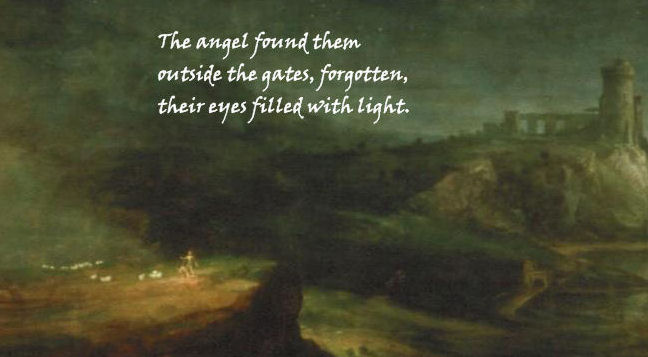
I need to look into this further, but I feel like I'm getting closer. I think my learning about personal surrender (from the 12 step spirituality) may also play into this, regarding the real meaning of "poverty of spirit." And I also am getting more eager to seek out and find the anawim as Jesus did, and be ready to join them (as Jesus also did) and love them. It makes me think of the image of the shepherds in my Christmas haiku:
The angel found them
outside the gates, forgotten,
their eyes filled with light.
2.07.2006
you poor
Perhaps the biggest problem I've struggled with here is my resistance to using threats or coercion against the guests here, especially because they are poor and vulnerable, while at the same time realizing that some of their choices and behavior make coercion seem necessary (both for them and others who live around them). I think a big part of my confusion in this area has had to do with my inattention to how Jesus spoke about and interacted with "the poor."
Of course, I've had help getting confused. There has been a great emphasis in past years on the poor, how Jesus spoke favorably of them and spent his time with them, etc. And the Catholic Worker emphasis on Mt 25 and "encountering Christ in the poor."
But, like I said yesterday, I have been aware that Jesus makes a distinction in how he talks about the poor. Once, during a discussion here, someone was talking about "Christ in the poor" and saying it was a mystery that we have to accept even when the poor person we've met isn't much like Jesus. He mentioned "blessed are the poor." But I pointed out that Luke 6.20 says: "He lifted up his eyes on his disciples and said, "Blessed are you poor, for yours is the kingdom of God.'" Jesus doesn't indicate all poor people, he says blessed are "you poor," and he's speaking specifically to his disciples.
Matthew's version says, "blessed are the poor in spirit." I've disliked how people use this version to detach blessedness from actual material poverty, but it does emphasize that material poverty itself does not produce blessedness. Jesus' words in Luke also indicate that, while material poverty is certainly involved (Jesus and his disciples are actually poor), it's not poverty alone but following Jesus in his poverty that is blessed.
Matthew 25 is also used heavily to support a certain view of the poor. I've written before about this. Jesus identifies himself with "the least of these my brethren," who have been in need of food and shelter, in prison, strangers. The focus seems always on the neediness when this is interpreted. And it's true that the "the least" are truly in physical need. But the phrase "these my brethren" is usually overlooked. Are all the poor really considered brothers and sisters of Christ? No where else does Jesus identify himself indiscriminately with the poor. Yet he often speaks of his "brethren" and identifies himself with his followers. Again, I think this carries the same message as the Luke passage. Jesus is speaking of real need and suffering. But he identifies himself with his suffering followers, his brethren, who are hungry, homeless, imprisoned, strangers in society because they are following him and facing the persecution he faced.
The blessed life and being identified with (one with, a brother to) Christ involves real need and poverty, but also more. "Poverty of spirit" is perhaps the best name for it. But I need to explore this more.
2.06.2006
"It is not enough to be poor in money."
In the letter from the Mahoneys, they said they hoped I was gaining a good understanding of the poor from my experiences here. That got me thinking.
A few days ago I quoted Luke 6.20 again: "He lifted up his eyes on his disciples and said, 'Blessed are you poor, for yours is the kingdom of God.'" I've written quite a bit on the connection between poverty and the blessed life Jesus promised, usually focusing on the fact that this was real material poverty that Jesus was talking about (and living). But in that emphasis I've skimmed over the reality that blessed poverty is a very specific and unusual thing. "It is obvious that all poverty is not 'blessed,'" I wrote in one entry, but that is all. At another point I quoted Ellul: "It is not enough to be poor in money. It is also important to be poor in spirit." I don't think I've given this enough attention, though.
Maybe one of the biggest lessons I've learned here is the difference between the person degraded by poverty (and suffering) and the person purified by it. I think I need to focus on that difference for a while and write some more about it.
2.03.2006
his life didn't look like that
I'm feeling pretty good today. It was warm and sunny on my walk to the student center this morning. And tonight I'm making pizza, which is always a big hit; sixty pieces are usually gone in no time. Also, a couple days ago I got an encouraging letter from the Mahoneys. They even suggested I might come for a visit sometime soon, which offers the hope I was really needing right then.
They also sent an old Catholic Worker article about a retreat they had at the house in New York years ago. It sounded really good. I can't imagine having something like that here; the group spirit just doesn't seem enough to pull it off. Accounts like that make me wonder if we're doing something wrong. If maybe the volunteers could have a better spirit and so lift the guests to be better themselves, instead of the reverse. Then I read Marc Ellis's A Year at the Catholic Worker this morning. It describes life at the New York CW in the mid-70s, when Dorothy Day was still there. And he doesn't sugar coat it. All the dirtiness, pettiness, hoarding, drunkenness, verbal abuse and violence are there. Much the same that we face, but considerably worse in severity.
I suppose this manner of life can be justified (even beatified) from some point of view, maybe an ascetic spirituality or isolated focus on certain gospel passages, like Matthew 25. But reading about those experiences, and matching them with my own, raises serious questions about whether this is really the "blessed" life. And then if we compare it to Jesus' life...
Catholic Worker spirituality likes to imagine Jesus in the bread line. But can we imagine Jesus as a worker there?
I really can't. His life didn't look like that. He didn't attract the same kind of selfish people, or live mired in dirt and abusive, despairing people. The hope this raises is that there is a "blessed" life that we are called to that is blessed in reality and not just in imagination. Jesus proved that.
1.31.2006
the blessed life
Jesus called his way of life "blessed." As in "Blessed are you poor, for yours is the kingdom of God." And I began to take that seriously once I realized that this didn't just mean our attitude about life would change, but that God would actually change our experience of life. God would make things happen both inside and outside us, providing for both internal and external needs. I experienced this most clearly in the way God provided for my material needs on my walks. It taught me more convincingly that I wasn't just experimenting with a philosophy or way of thinking but was dealing with the God of the universe, who could really change things. Who could really provide a "blessed" life.
My struggles over the past few months left me confused, though. Where was this God who had provided so readily and so well? Why was I stuck in this place where it seems so hard to find meaning or know how to contribute well, where it seems so hard to love?
Some insight into my own faults and weaknesses has helped me see why this rough time might be good for me. But even while passing through this hard period, I'm seeing God providing what I need to make it. Real things, things that I couldn't arrange myself. One thing was the newsletter from the Catholic Worker retreat center that I picked up off the desk and found a possible next step. And talking to them provided a goal and project (studying 12-step spirituality) for these next months. A project that has turned out to be very interesting and helpful. Without those things, I don't think I could have endured the time here.
And last weekend I got a call from Evanston. Julius invited me to come back to my old household in Reba Place Fellowship for a couple weeks to work with Bob (who I used to work with when I lived there), teaching computer skills. That sounds like a break I really need. So I'm going in two weeks.
"Your Father knows your needs," Jesus said. And he is able to meet them. In harder times, it's not as easy to hold onto faith that God is near and helping. But when we do get signs of his care, they mean so much more. Life can seem blessed even when it's dark and threatening all around.
1.30.2006

1.27.2006
trying not to "enable"
After the last entry, Rose commented: "The challenge is to integrate co-dependency teachings with Jesus' teachings and the spiritual works of mercy, bearing wrongs patiently, suffering for their sakes, etc."
Yes, that is a challenge. I've been put off in the past by a lot of the psychology-based terminology like "co-dependency" (I remember Heather and my first exchange was an argument about "boundaries") but there is something important there. I think the psychological definitions of these problems are a bit lacking, since their model for "healthy" doesn't tend to be Jesus' model. I'm sure many psychologists would find Jesus' behavior quite alarming, even masochistic. But they do identify a real problem in many people. I guess I think if the problem could be defined more clearly (in Jesus' terms?) then there wouldn't be so much friction between "good boundaries" or "taking care of myself" and the selfless love that Jesus taught.
I've been struggling with something close to this myself lately. Personally I've had the most difficulty trying to help people who are clearly not helping themselves, who are often ungrateful, who are working against those who try to help them. What to do? Keep giving handouts? "Tough love" (whatever that means)? The 12-step teaching about letting someone's own behavior and suffering show them that they need help makes sense to me, and seems to be built on a faith in God's providence. Also, Jesus' practice of not storing up the "treasures" that these people go after in their self-destructiveness (money especially) also seems very helpful. Both of these practices would help avoid what the psychologists call "enabling." But I'm having a hard time figuring out how to start applying those here, where the practice is to give without considering the "worthiness" of the person. I'm starting to think that's not so holy as it might sound. Yes, God sends sun and rain to the just and unjust, but sun and rain only produces food for the person willing to plant and tend and harvest.
Not that this experience is turning me into a economic conservative. (At least I hope not.) It's just obvious that economic liberalism isn't right either. It's pretty horrible to see what so many welfare checks end up paying for. There has to be a radical Christian response--and I don't see shelters as the answer. Personal Christian hospitality seems closer. And Jesus' way of life seems the best yet.