virginia
Here's some pictures the Mahoneys sent from Virginia. The big retreat house is in the front, with the little cottage they live in behind it.
Here's some pictures the Mahoneys sent from Virginia. The big retreat house is in the front, with the little cottage they live in behind it.
One point I especially appeciated in that Christianity Today article I quoted yesterday was the contrast in economic practice illustrated by George Müller and Dwight L. Moody:
Müller was less interested in caring for orphans than in demonstrating God's power: "The chief end for which the institution was established is that the church would see the hand of God stretched out on our behalf in answer to prayer." Müller never borrowed money, nor would he ever mention the orphanage's current needs to anyone. He was, nevertheless, a tireless and relentless publicist. For 50 years, he wrote copiously and traveled widely, telling dramatic, nail-biting stories about the orphanage's desperate needs, its fervent prayers, and God's never-failing last-minute rescue from disaster.
Moody, by contrast, was bold as the winter wind in asking for money. He used personal appeals to people's religious sentiments, buttonholing industrial tycoons and sending out thousands of what he cheerfully called "begging letters" every year.
...Moody's method of fundraising prevailed over Müller's. After 1945, evangelicalism gradually abandoned its old faith principle of praying rather than asking. This freed evangelical organizers to dream up new ways of raising funds that produced more money than simply praying.
It is important to remember that evangelicals first adopted faith principles as a way to demonstrate God's power, not because faith principles were an especially efficient way to raise money. In the years since World War II, evangelical entrepreneurs have showed less interest in demonstrating God's providential care and more in growing their ministries.
I've begun to have thoughts about going out walking again. One motivating theme that has risen to the surface of my mind has to do with Christian ministry. Perhaps a good introduction would be this journal entry from over five years ago (I guess it's a continuing theme for me...):
January 23, 2001
I found this passage in an article by Richard John Neuhaus (in this month's issue of First Things):
Even in these flush times, $22 billion is a hefty piece of change. That is how much evangelical Protestants spend annually in support of a vast array of parachurch groups, ranging from Campus Crusade for Christ, World Vision, and Prison Fellowship to countless evangelistic ministries. Michael S. Hamilton offers an instructive survey of the phenomenon in a Christianity Today article, "We're In the Money!" ...So has the success of the innumerable entrepreneurial empires of the parachurch world corrupted evangelicalism? Hamilton recognizes that being in the money is probably not what Jesus had in mind when he invited his disciples to take up the cross and follow him:Given the enormous temptations to sin that always accompany wealth, it is a bit surprising that we have displayed so little ambivalence at the wealth that is now in our hands. I suspect this is so because we believe in the marrow of our bones that our ministry organizations are doing God's work in the world. So any decision that might lead to a decrease in an organization's activities will hinder God's work (not to mention threatening the livelihood of its employees).If only the world, and the religious world as well, was limited to "the best cases." What would seem to be missing here is a place to stand from which the driving, and sometimes demonic, logic of growth and success can be brought under judgment. I left the article wondering whether somebody might someday write a version of "The Grand Inquisitor" updated for the religion business of our day.
Once this conviction is in place, the very act of preserving and defending the ministry becomes a self-evident, self-sustaining virtue. And it nurses the common idea that when an evangelical organization prospers, the prosperity is a sign of God's approval. Such thinking is not biblical, of course. The Bible makes it clear that God often gives good gifts to those who do evil. It is equally clear that when Christians do as God asks they will sometimes lose money, respect, freedom—and even life itself.
This particular Christian truth only rarely works its way into the decision-making process of our ministry organizations. The engine that drives us is a compelling vision for ministry, and who can say that the vision was not vouchsafed by God? So we pursue the vision by building and growing the organizations that embody the vision. Growth means more money; more money means more ministry. In the worst cases, means and ends become reversed, and growth and influence become goals unto themselves. In the best cases, more ministry means more people who become newly aware of the great gift God has given them in Jesus Christ--and who then, in gratitude, reach into their own pockets and give, so that others might also know.
Speaking of celebrations and joy, Heather and I have been together two years now. In honor of our anniversary, I put together a little something...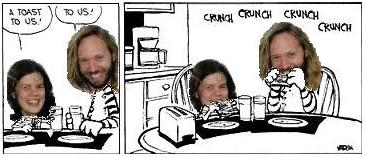
We also just found out that Heather will be able to go with her good friend to Nigeria this summer and work with the Mashiah Foundation. It's a great opportunity and I'm glad she's going. Though it will be hard being apart so long (she's leaving in June and probably not coming back until after Christmas).
She's dreamed of going to Africa for a long time, which also means she'll be discerning if God might want her to stay there. That makes it extra hard for me. But yesterday I remembered these words, written in my journal very early in our relationship, almost two years ago:
...I learned that what I am called to in my relationship with her is a lot like faith. That I cannot "hold" her. That I have to let her go (again and again) so that she is always free to give herself. Or not. But, in any case, she must be free or it's not love.
Heather and I had a great Easter celebration back up in Evanston. That may be the last time we are there for quite a while, so I'm glad it was so good.
The overwheming enthusiasm of the celebrations, though, made me stop and think. And I was reminded of a journal entry from over five years ago. I think it still raises some interesting points...
January 3, 2001
Great joy does not gather the rosebuds while it may;As I've thought about these lines [by G.K. Chesterton], I've become more conscious of the true nature of joy. It has the nature of goodness, as a sharing of God's own nature. Thus true joy springs from an eternal source.
its eyes are fixed on the immortal rose which Dante saw.
The tremendous figure which fills the Gospels towers in this respect, as in every other, above all the thinkers who ever thought themselves tall. His pathos was natural, almost casual. The Stoics, ancient and modern, were proud of concealing their tears. He never concealed His tears; He showed them plainly on His open face at any daily sight, such as the far sight of His native city. Yet He concealed something. Solemn supermen and imperial diplomatists are proud of restraining their anger. He never restrained His anger. He flung furniture down the front steps of the Temple, and asked men how they expected to escape the damnation of Hell. Yet He restrained something. I say it with reverence; there was in that shattering personality a thread that must be called shyness. There was something that He hid from all men when He went up a mountain to pray. There was something that He covered constantly by abrupt silence or impetuous isolation. There was some one thing that was too great for God to show us when He walked upon our earth; and I have sometimes fancied that it was His mirth.Jesus himself spoke of his own joy, and commended it to his disciples: "These things I have spoken to you, that my joy may be in you, and that your joy may be full."(Jn 15.11) But it does seem that his joy was somehow restrained or hidden. That's odd.
I had recently read the "Give to Caesar" story in Luke 20 when I noticed an online discussion on tax exemption yesterday (suggesting that churches avoid tax exempt status). It's a relevant topic for me. Here's most of what I wrote:
In general I agree with the arguments about not cooperating with the government when what they demand is wrong. Not too long ago I wrote an article about my experience going AWOL from the Navy (then later turning myself in to accept the consequences of my choice) and how I think that my non-cooperation was better than applying for CO status. (The folks at the Catholic Peace Fellowship asked me to write it; it's available as an RTF file here.)
But of course this all depends on what we think about paying taxes. I know many people here (and in the Catholic Worker movement) advocate tax resistance. But I agree with others who think Jesus said (and demonstrated) pretty clearly that we should pay taxes when they are due, since Caesar's power is what establishes and guarantees the value of money (in people's minds; it has no absolute value) and we should "give to Caesar what is Caesar's." Money seemed to be of little value to Jesus, so he saw no point in resisting or struggling over it. But I don't want to get in an argument here on this subject (I've argued it at length in this forum long ago, and even posted a short story on the topic--if anyone's interested, it's here).
If we as Christians should pay the taxes demanded by the government, then I don't see any problem in accepting their provisions for tax exemption. It's their money, their tax, they get to set the rules. (In a way, I personally accept tax exemption now, since I don't make enough income to have to file, according to the government's rules.) But of course I agree that this shouldn't limit our critical speech or actions, shouldn't stop us from telling the truth. We should be willing to tell the truth even if it means losing tax exempt status. But I would expect that in most cases, the government is not paying much attention to what some little group is saying or printing in it's newsletter. That church that got the IRS inquiry seems like it was very big and pretty influential politically, which is why they caught the government's eye. I would imagine for most of us here, we aren't interested in promoting any political party and maintaining tax exempt status wouldn't interfere much with what we want to do or say.
The Catholic Worker I live at now is non-profit and tax-exempt, and the one I'm moving to this summer is that way as well, as far as I know. I didn't set them up that way, but I don't see any reason to encourage them to change and start paying taxes. (Of course, if people do choose to reject tax-exemption, I have no problem with that--unless they start arguing that Christians shouldn't pay taxes.)
I've been working on the layout for the newsletter and it's looking good. Stayed up too late last night editing, then got up early with an idea to improve the masthead. I find it very satisfying to do work like this.
Here's a shot of the front page (click on the image for a larger version):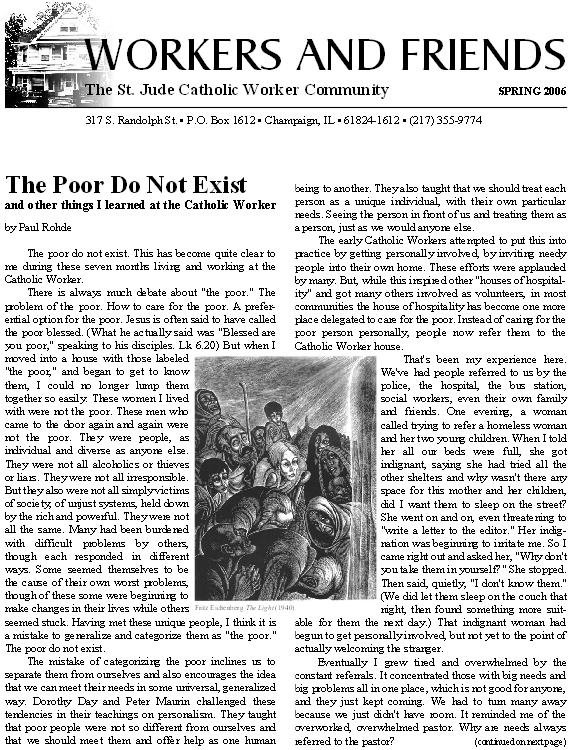
 The pink magnolia trees are starting to bloom. Heather and I noticed them Sunday when we went to the park to enjoy a few hours reading together in the sun.
It seems my experience here has been in tune with the seasons. My lowest points were in late December and January. And now, as everything warms and greens, I'm enjoying a very good time here. Like I've said before, I'm glad I stayed (and didn't leave in January) or I'm glad I was made to stay. Not only did it give me a better look at my own darker side, but I also managed to work out some of the struggles I had here and learn how to respond better to some of the harder situations. And I was able to decide to leave, not out of desperation or fear, but out of conviction. (Those convictions are reflected in the article I just posted.) That feels very good.
And life's gotten easier now, too. Almost every day I've been able to spend half the day at the Methodist student center, using the computer or just enjoying the quiet. And I actually have my own room now (after seven months without). The Mahoneys' letters continue to be encouraging ("So much of what you say really seems to point to this being a perfect place for you two to join in--we are encouraged and most hopeful"). And the end here is in sight.
On top of all that, Heather and I are spending a long Easter weekend in Evanston, then there's a house retreat at a nearby state park during the last weekend of the month. And spring.
Our hope is in you, Father, who richly provide all things for us to enjoy.
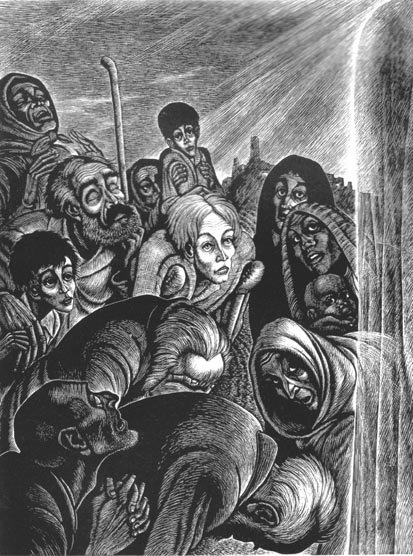
I found this copy of Fritz Eichenberg's "The Light" online. It's probably my favorite of his; it hangs in the dining room here. I'm going to put it in the newsletter to accompany my article.